
Poet, Counterculture Icon on Mossadegh, 1953 Coup
| Arash Norouzi The Mossadegh Project | March 24, 2008 |

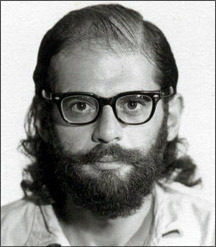
Poet, professor, activist, and 60’s counterculture icon Allen Ginsberg (1926-1997) is most famous for his expansive poem Howl (1956) which chronicled the fate of his peers in the Beat Generation. Ginsberg was a shrewd observer of American imperialism; and U.S. intervention abroad shaped his political beliefs significantly.
Perusing his writings and interviews, it becomes apparent that the overthrow of Mossadegh left a strong imprint, influencing him throughout his lifetime.
In 1960, he skewered anti-Mossadegh propaganda in his poem Subliminal. During the hostage crisis of 1980, Ginsberg took the opportunity to point out that Iran itself was the hostage of the U.S. for the previous quarter century in his anti-establishment manifesto, Capitol Air. And in 1991, during the Gulf War in Iraq, Ginsberg linked the coup with America’s prior support for Saddam Hussein in his poem Just Say Yes Calypso.
In one of his final poems, written a few days before he died in 1997, Ginsberg listed the 1953 coup in his signature anti-imperialist/anti-capitalist swan song, Thirty State Bummers.
Here is a chronology of relevant writing and commentary by Allen Ginsberg, 1960-1997.
One million editorials against Mossadeq and who knows who Mossadeq
is any more?
Me a Democracy? I didn’t know my Central Intelligence was arming
fascist noodnicks in Iran.
This true story I got from High Sources Check yr local radio announcer
All I remember’s nasty cartoons in N.Y. Mirror long-faced Mossadeq
blubbering in a military court in Persia
looking the opposite of a serious hair’d Central Intelligence Agent sipping
borscht cocktails at a Conservative egghead soirée
— Subliminal (October 1960)
Allen Ginsberg was 27 years old at the time of the 1953 coup. Seven years later, he recalls the episode with characteristic skepticism, anger and disbelief over his country’s actions.
What was really shocking was that the old-line liberals & socialists like yourself after 20 years of McCarthyism are completely out of contact with any kind of perspective on what’s happened to America. Put it this way — to my generation, the Cuban scene is similar to the old Spanish Civil War scene — with many of the same stresses and interior conflicts.
I don’t see any way out except full public investigation of CIA activities in Guatemala, Iran, Cuba, Formosa, Korea, Laos, Congo, etc. for the last 10 years — total reversal of policy of secret manipulation of foreign policy and hiding or withholding news and info from public — the extent of which nobody knows fully but what I already know has made me gasp with horror and has justified the worst Russian tirades in the U.N.
— Allen Ginsberg (June 12, 1961)
Letter to his father from Tangier, Morocco while visiting William S. Burroughs. In the wake of the Bay of Pigs invasion, Allen was preoccupied more than ever with Cuba and Castro.
Source: Family Business: Selected Letters Between a Father and Son (2001)
September
Mossadek weeping in Court
1962 Recalled to the Front
Pages
It all Comes out
the C.I.A. Him overthrew
because
His government fell
Because
He Nationalized Albion-Persian Oil Company!
That dirty board of Directors!
— Allen Ginsberg journal (September 1962)
Excerpt from Indian Journals (1970), a collection of writings from Ginsberg’s travels in India in 1962-1963. Albion was the original name for Britain.
The Generals say they know something worth fighting for
They never say what till they start an unjust war
Iranian hostage Media Hysteria sucks
The Shah ran away with 9 Billion Iranian bucks
Kermit Roosevelt and his U.S. dollars overthrew Mossadegh
They wanted his oil then they got Ayatollah’s dreck
They put in the Shah and they trained his police the Savak
All Iran was our hostage quarter-century
That’s right Jack
— Capitol Air (December 15, 1980)
In Capitol Air, Ginsberg rails against a jumbled litany of worldwide political grievances. Referencing the hostage crisis and the media circus surrounding it, Ginsberg points to the lesser known 1953 coup the lesser known coup which produced it. “All Iran was our hostage quarter-century...”
Capitol Air would become one of Ginsberg’s more famous works. Within the next two years, he would perform it live with The Clash and on David Letterman’s TV show.
In one of his last interviews, Allen Ginsberg proposed that the U.S. apologize for the overthrow of Mossadegh, among other crimes. This excerpt is from Dr. Gloria G. Brame’s interview with him in 1990, the 2nd part was conducted and published, along with the first, in 1996.
Q: Going back to poetry--will you write another "Howl"?
Allen Ginsberg: Well, it would be impossible. But I’d like to write something that addressed the increasing
strangulation of liberty in America, and the corruptions of the government in violating the soul.
Q: By violating individual rights?
Allen Ginsberg: There’s the national soul, the national spirit. It has been violated by our government’s actions.
I think we, as a nation, need to apologize. One of the things we would have to apologize for, which would be included
in such a poem, would be the overthrow in Iran, which led to the Shah and then the Ayatollah. That’s CIA business.
Or the destabilization of Prince Sihanouk of Cambodia, which led to the killing fields. There’s the destabilization of
Chile, in the early Seventies. We have to apologize for not signing the Geneva Treaty ending the French Indochina War.
We have to apologize for maintaining the death squads military in Salvador. We have to apologize for violating international
law in mining the harbors of Nicaragua, which was judged by the World Court to be in violation of law. We have to apologize
for loosing hyper-industrialization on the world, which is destroying the environment. We have to apologize for the murder
of the Native Americans. We have to apologize for maintaining slavery for several hundred years, then denying African-Americans
the vote until my lifetime, a hundred years after the Civil War, and for still maintaining a racist outlook and laws. There
is a lot we have to apologize for.
You wish to make those apologies in your poem?
Allen Ginsberg: That’s a good way of beginning it. “I, America, hereby apologize for...” You gave me a great idea!
It would have to be a poem that was full of grief, because I think that’s the heart of America at the moment. Not the bravado,
and the chauvinism, and the violence--these things are the mask of grief for what we’ve done to ourselves and to the world.
The third in Ginsberg’s Calypso trilogy, Just Say Yes Calypso begins:
When Schwarkopf’s Father busted Iran’s Mossadegh
They put in the Shah and his police the Savak
They sucked up his oil, but got Ayatollah’s dreck
So Thirty years later we hadda arm Iraq
Though he used poison gas, Saddam was still our man
But to aid the Contras, hadda also arm Iran
— Just Say Yes Calypso (April 25, 1991)
Ginsberg connects the Gulf War by reminding us that General Norman Schwarkopf’s father was involved in the 1953 coup, which led to the Iranian revolution, U.S. support for Iraq, Iran-Contra, and ultimately the Gulf War itself. (As Ginsberg explained in a 1994 interview excerpted below)
Ginsberg’s posthumous poetry volume, Death & Fame: Last Poems 1993-1997, included this open letter to new President Bill Clinton—a grocery list of wants:
Purge U.S. military death squad subsidies in Salvador, Guatemala, etc.
We backed up dictators in Zaire, Somalia, Liberia, Sudan,
Angola, Haiti, Iran, Iraq, we’re responsible; admit
it then figure ways out.
Open CIA & FBI & NSA archives on Cointelpro raids, Government drug
dealing, Kennedy/King assassinations, Iranian Contragate,
Panama Deception, Vatican, Hand & Lavoror Bank thuggery, etc.
including Bush-Noriega relations and other CIA client-agent scandals.
Open all files on J. Edgar Hoover-Cardinal Spellman-Roy Cohn-
Joe McCarthy alcoholic Closet-Queen Conspiracy with Organized
Crime to sabotage the U.S. Labor Movement, Native African-
American Hispanic and Gay minority leaderships; and blackmail
U.S. Presidents Congress each other for half century.
Get Government Secret Police (DEA CIA FBI NSA etc.) off our backs
by the next millenium.
— January 17, 1993
Excerpt from The Progressive magazine interview with Allen Ginsberg on August 1, 1994 by Matthew Rothschild, discussing the Gulf War waged by President George H.W. Bush:
Q: One of my favorite poems in Cosmopolitan Greetings is “After the Big Parade”--about the American public’s reactions to Bush’s Iraq war. Were you actually at one of those parades here?
Ginsberg: I was down in the parade with a tiny group of people protesting it in front of City Hall. There was a group of maybe ten people amid the millions that were out there under the confetti, and the bunting, and the bands, and the police.
Q: How did the crowd respond to you?
Ginsberg: They ignored us, or they threatened us. So I saw it first hand, the mob hysteria, as in the old Roman mob. And then within two days the entire enthusiasm had evaporated, and within a few months, people realized more and more that the Iraq war was one of the most successful instances of brainwashing ever turned out by Madison Avenue and Government--by control of the airwaves and mass-media censorship.
In hindsight, people realize that they were taken in, that alternative views weren’t presented, and that in order to present this war as heroic, you had to ignore some very obvious things-- like the fact that we were building up Saddam Hussein until the very day that we bombed him, and that we had played one gang against another in the Iran-Iraq war.
In a way, we were responsible for the whole Middle East situation. We had overthrown Mossadegh, as I’ve got in my poem, Just Say Yes Calypso. Norman Schwarzkopf’s father was directly involved in the overthrow of Mossadegh and the training of the Savak. People weren’t aware of that. People thought Schwarzkopf was some sort of country bumpkin from the Midwest who got to be general rather than a sophisticated Persian-speaking son of a man who trained the Shah’s secret police. [H. Norman Schwarzkopf]
So it was some kind of American karma we were bombing, and people weren’t really aware of the historical relevance of the land they were bombing, that this was the Garden of Eden we were bombing, the land of Ur and Abraham. And they didn’t realize in a way that it was child molestation, because the average age of Iraqis at the time was only sixteen. The people being bombed were kids!
Allen Ginsberg was interviewed for the CNN’s 24 episode series "CNN: Cold War" on August 11, 1996. The series aired in 1998, and the complete interview transcript was later made available by the National Security Archive at George Washington University.
Could you tell me how you personally experienced the restrictive Cold War atmosphere that came through the ‘50’s?
ALLEN GINSBERG: Well, part of that atmosphere was the sort of anti-Communist hysteria of McCarthyism, but culminating in ‘53 or so, with the execution of the Rosenbergs. It was a little harsh. Whatever they did, it wasn’t worth killing people, you know, killing them. I remember sending a wire to Eisenhower and saying: “No, that’s the wrong thing.” Drawing blood like that is the wrong thing, because it’s ambiguous; and especially, there was one commentator on the air, called Fulton Lewis, who said that they smelt bad, and therefore should die. There was an element of anti-Semitism in it. But I remember very clearly on the radio, this guy Fulton Lewis saying they smelt bad. He was a friend of J. Edgar Hoover, who was this homosexual in the closet, who was blackmailing almost everybody.
But that year, ‘53, I was living with William Burroughs in New York, and he was conceiving the first routines of Naked Lunch, which were parodies of Cold War bureaucracy mentality and police state mentality. And I remember that year very vividly, that Mossadegh was overthrown in Iran, in Persia, because it was suspected that he might be neutral, or left, though he wasn’t, but he really wanted to nationalize the oil fields, which the Shah later did anyway. And I remember the CIA overthrew Mossadegh, and he wept in court; and we’ve had karmic troubles and war troubles with Iran ever since. That was the seed of all the Middle Eastern catastrophe we’re facing now.
[At the] same time, in 1953, the Arbenz government in Guatemala was overthrown, and I was much aware of that, despite the neutrality of the American papers and the lack of real reporting. [Jacobo Arbenz was deposed in 1954] The actual event was that Allen Dulles was running the CIA, I believe; John Foster Dulles was Eisenhower’s Secretary of State; they both had relations to the... I think it was the Sullivan and Cromwell law firm. The Sullivan and Cromwell law firm were representing United Fruit, and so, for the United Fruit’s interests we overthrew a democratically elected leader ... Jacobo Arbenz in Guatemala. And that was followed by... well, what is it?... 30 years or 40 years of persecution of the Guatemalan indigenous peoples, with the death of 200,000 of them — at least so the New York Times says — particularly under the later leadership of General Ríos Montt, who turns out also to have been a disciple of Pat Robertson, the right-wing moralist, Bible-thumping Christ announcer, assuming for himself the morality and ethics of Jesus.
 So many, many seeds of karmic horror: mass death, mass murder, were planted in those years, including, very consciously for me — I was quite aware of it — the refusal of John Foster Dulles to shake Zhou Enlai’s hand at the Geneva Conference which ended the French war in Indochina, or was supposed to end it. Now the Americans had been sending France $40 million a year to pursue that war, and then the Americans cut off the funds, so the French didn’t have funds. But as Bernard Fall points out, and many others, General Salan and others maintained the war through the proceeds of the opium sales in Chelon, the Chinese section of Saigon, and the war was funded for a while by them. Then, when the Americans finally took over, with a puppet president, Diem who had been cultivated in the Merinal Academy in the East Coast by Cardinal Spellman... another flaming faggot, who in disguise was a sort of a war dragon and one of the instigators of the Vietnam War... so Diem was a Catholic, and we had installed him as the puppet in a Buddhist country. So, when I arrived in Saigon in 1963, coming after several years in India, I was astounded to find that this Buddhist country was being run by a Catholic American puppet. And, in sitting down with David Halperstam and I think Charles Morer and Peter Arnett and others, who were reporting for the American newspapers, I got a completely different idea in the early ‘60’s, ‘63, May 30th ‘63 to... oh, June 10th or so... completely different idea of what was going on in the war than I’d had reading the papers abroad or in America. They all said that the war could not be won; there was no light at the end of the tunnel; and Ambassador Lodge’s reports to the President were false, or hyper-optimistic and misleading; and that they were getting flak and criticism for reporting what they saw on the spot there. But to go back to the ‘50’s, what was ... it felt like in the ‘50’s — given all these karmic violent errors that the CIA was making in Iran, in Latin America, the real problem was that none of this was clearly reported in the press. It was reported with apologies or with rationalizations or with the accusation that Arbenz was a communist, or that Mossadegh was a communist. Mossadegh was mocked, especially when he wept in court, with tears that were tears, and very tragic, both for America and Iran. And he was considered ... you know, in Time magazine, which was sort of the standard party line, like the Stalinist party line, he was considered the... you know, some kind of jerk.
Of course, in those days Walt Whitman was considered a jerk, and William Carlos Williams was considered a jerk, and any sign of natural man was considered a jerk. The ideal, as you could find it in advertising in the loose organizations, was the man of distinction: actually, a sort of British-looking guy with a brush moustache and a tweed coat, in a club library, drinking — naturally — the favorite drug, the drug of choice of the Establishment. And this was considered and broadcast as... advertised as the American century. Well, you know, Burroughs and I and Kerouac had already been reading Oswald Spengler on the decline in the West and the cycles of civilizations, and found this proclamation of the American century a sort of faint echo of Hitler’s insistence on his empire lasting 1,000 years, or the Roman Empire’s neglect of the central cities. And we were thinking in terms of the fall of America, and a new vision and a new religiousness, really, a second religiousness, which Kerouac spoke of in the ‘50’s, and exemplified, say, with his introduction to Eastern thought into the American scene, from the beginning of the 1950s through his book Mexico City Blues, poems which were Buddhist-flavored, through his open portrait of Gary Snyder in The Dharma Bum(s), the book The Dharma Bums — a long-haired rucksack revolution, a rebellion within the cities against the prevailing war culture, and a cultivation of the countryside and the beginning of ecological considerations and ecological reconstruction.
Allen Ginsberg’s half-century of prose came to an end on March 30, 1997. Thirty State Bummers, dated March 24th, is one of the last poems he wrote. Ginsberg succumbed to liver cancer 12 days later, on April 5, 1997.
Lots began in ‘53
Guatemala couldn’t break free
United Fruit annulled the vote
As Alan & Foster Dulles gloat
Then unseated Mosaddeq
& left Iran a police-state wreck
Then we sold the guys in Iraq
Money to bomb Iranians back
— Thirty State Bummers (March 24, 1997, 10:40 P.M.)


Related links:
The Dulles Brothers: how to wreak havoc in Guatemala and Iran
Eisenhower’s Diary, 1953: If CIA Coup in Iran Discovered, It Would Be Embarrassing
Operation Ajax Was Always An Open Secret—A Timeline
MOSSADEGH t-shirts — “If I sit silently, I have sinned”


