
Premier’s 1952 Resignation Ignites Massive Protest
| Ebrahim Norouzi, MD The Mossadegh Project | July 20, 2009 |
In June 1952, Dr. Mohammad Mossadegh traveled to the Hague to argue that the International Court had no jurisdiction to decide on the British complaint over Iran’s oil nationalization drive.
“There is no political or moral yardstick by which the court can measure its judgment in the case of nationalization of the oil industry in Iran”, he argued, “...and that under no condition will we accept the jurisdiction of the court on the subject. We cannot put ourselves in the dangerous situation which might arise out of the court’s decision.” The verdict was to be announced later, and Mossadegh returned to Tehran on June 23rd, having won the respect of the presiding judges.
Three weeks after his return on July 16, 1952 [Wednesday 25 Tir 1331], Mossadegh held a private meeting with Mohammad Reza Shah that lasted around three hours. He explained to the Shah that in order to deal more effectively with the illegal activities of the domestic and foreign elements against his government, he needs to have more executive power.
To this aim, he requested that he be trusted with the control of the armed forces, a role the Shah had kept for himself. According to the Constitution, a Prime Minister could also be Defense Minister, so the request was perfectly legal. The Shah refused, however, and Mossadegh in response immediately offered to resign, unless the Shah changed his mind by later that day. The same evening, Mossadegh formally submitted his resignation, shocking people around the country.
The following day, the Shah, at the behest of British and American governments, appointed the elderly politician Ghavam Saltaneh to the position of Prime Minister. Ghavam, fearing general strike and chaos, took a hard line and in a communiqué warned the nation that:
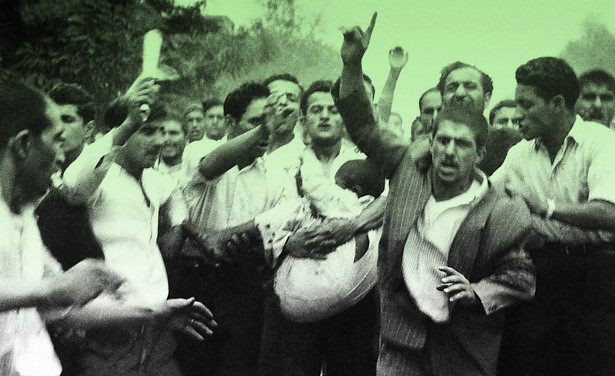
This approach exacerbated people’s displeasure with the new government and they poured into the streets with cries of “Give me death, or give me Mossadegh”. The police and security forces, unlike the period under Mossadegh, took a harsh and confrontational stand against the the demonstrators.
The largest demonstrations took place on the third consecutive day of protests, July 21, 1952 (known as 30th of Tir). The armed forces shot at the protesters, killing dozens, yet later stopped their fire, some even joining the people. Besides mostly traditional supporters of Mossadegh and members of National Front, his long time committed companions and deputies threw their full support behind him. Many bazaar merchants, teachers, students and others joined the demonstration. Ayatollah Kashani brought along a large number of his followers to participate in the demonstrations, though his support mostly reflected his opposition to Ghavam rather than support for Mossadegh; likewise for the Tudeh [Communist] party, who saw Ghavam as a tool of the West.
 |
Witnessing the depth of the people’s support for Mossadegh, the Shah became highly alarmed and reversed course. Ghavam resigned and the Shah re-appointed Mossadegh as Prime Minister and gave him the Ministry of Defense, as Mossadegh had requested it five days earlier. Ironically, on the same day the International Court at the Hague voted in favor of Iran and against the British in their dispute. This was followed by the U.N. Security Council’s rejection of the British claim. Mossadegh was at the height of his power and popularity, hailed as a hero not only in Iran, but in the greater Middle East.
Mossadegh never forgot the people who died on that bloody day. In his will, written in the final years of his life, Mossadegh specifically asked that he be buried in the cemetery belonging to the martyrs of 30 Tir. The Shah, by that time an absolute monarch installed and supported by the West, did not grant the request.
 |


Related links:
MOSSADEGH, Islam and Ayatollahs
August 19, 1953: The Day Iran’s Democracy Died
Mossadegh’s Final Hours as Prime Minister
MOSSADEGH t-shirts — “If I sit silently, I have sinned”


